

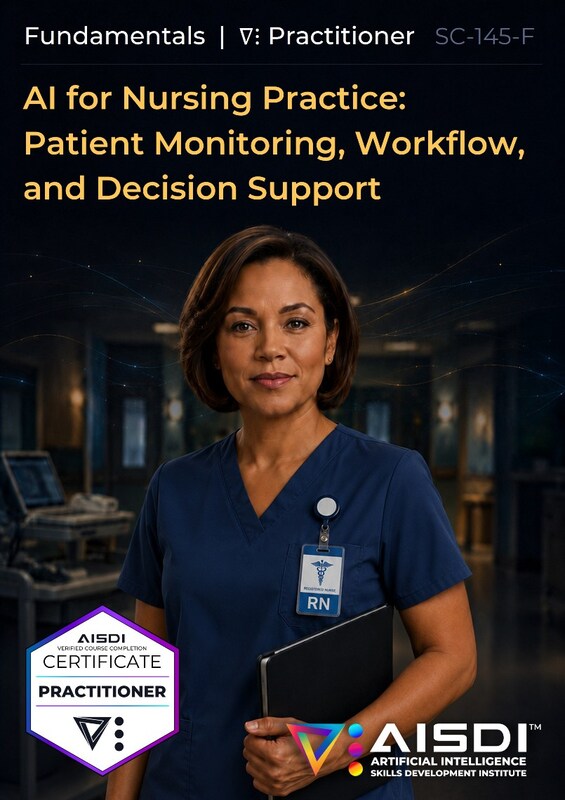
AI for Nursing Practice: Patient Monitoring, Workflow, and Decision Support
Share :
Course Details
Nursing teams are increasingly encountering AI-enabled tools in patient monitoring, documentation, workflow coordination, risk alerts, and care communication. These tools can support better responsiveness and reduce administrative pressure, but they can also create new risks if alerts are misunderstood, documentation is overtrusted, or human judgment is weakened.
1Course Description
This Fundamentals course introduces AI’s practical role in nursing practice. It focuses on how AI can support patient monitoring, early risk detection, shift coordination, documentation, communication, and everyday decision support while preserving the central role of nursing judgment and patient-centered care.
The course is written for nursing and care-delivery contexts, not for data scientists or technical system builders. Learners examine what AI tools can do, how alerts and risk flags should be interpreted, where AI may reduce routine workload, and where professional oversight remains essential.
It provides a practical foundation for nurses and care teams who need to work confidently and responsibly with AI-enabled systems in clinical or care settings.
2What This Course Helps You Do
This course helps nursing professionals understand how to use AI as a support layer rather than a replacement for clinical judgment. The practical value is clearer interpretation of AI-supported alerts, better workflow awareness, safer documentation habits, and stronger confidence when AI appears in everyday care settings.
For nursing teams, this can support more consistent communication, better escalation thinking, and more organized shift workflows. For ward managers and healthcare organizations, it supports practical AI readiness at the care-delivery level, where adoption succeeds or fails through daily use.
3What You Will Learn
By completing this course, learners will be able to:
- Understand what AI means in a nursing environment and where it may appear in everyday care workflows
- Identify common AI-supported tools used in monitoring, alerts, documentation, scheduling, and communication
- Interpret AI-generated alerts, risk flags, and monitoring outputs with appropriate caution
- Recognize the difference between AI-supported insight and clinical judgment
- Use AI concepts to improve shift coordination, escalation thinking, and care-team communication
- Understand how AI can support patient monitoring and early risk detection
- Identify documentation tasks where AI may assist without compromising accountability or accuracy
- Communicate AI-supported observations clearly to colleagues and care teams
- Recognize ethical issues linked to patient privacy, dignity, bias, safety, and overreliance
- Apply practical boundaries for using AI in patient-facing care environments
- Build AI readiness into everyday nursing practice without treating AI as a substitute for professional responsibility
- Prepare for further healthcare AI learning in patient care, clinical workflows, and healthcare governance
4Who This Course Is For
This course is intended for nurses, ward managers, care-delivery professionals, nursing educators, healthcare supervisors, and clinical support teams who need a practical foundation in AI-supported nursing workflows.
It is suitable for non-technical healthcare learners. Clinical experience is helpful, but programming or data-science knowledge is not required. The course is especially relevant for teams preparing to encounter or adopt AI-enabled tools in patient monitoring, documentation, or workflow coordination.
5Why This Course Matters
Nursing work is high-pressure, human-centered, and operationally complex. AI can help with alerts, documentation, coordination, and routine decision support, but poor implementation can create confusion, overreliance, data concerns, or missed clinical context.
This course matters because nurses need practical AI literacy that respects clinical judgment. Better understanding helps care teams use AI-supported information more carefully, communicate more clearly, and protect patient-centered care while adapting to new tools.
6Module Overview
This course introduces AI in the nursing environment, then moves into patient monitoring, workflow coordination, documentation, ethical boundaries, and everyday AI readiness for nursing practice.
The course includes the following modules:
- Module 1: AI in the Nursing Environment – What It Is and What It Does
- Module 2: AI-Supported Patient Monitoring and Early Risk Detection
- Module 3: Workflow and Shift Coordination With AI Support
- Module 4: Documentation and Communication With AI-Enabled Systems
- Module 5: Boundaries, Ethics, and Clinical Judgment
- Module 6: Building AI Readiness Into Everyday Nursing Practice
7Practical Outputs You Can Produce
AISDI™ courses are work-product-driven. This means learners are encouraged to turn course ideas into usable outputs such as notes, prompt sets, checklists, decision aids, plans, templates, review routines, and role-specific artifacts. The examples below are indicative only. Learners can use ALMA™ to adapt outputs to their own role, industry, organization, workflow, current priorities, and practical constraints.
Examples of practical outputs from this course may include:
- Patient-monitoring AI notes
- Early risk flag interpretation checklist
- Shift coordination improvement notes
- Escalation communication prompt set
- AI-supported documentation review checklist
- Patient privacy and dignity reminder guide
- Nursing workflow readiness map
- Care-team communication script examples
- Clinical judgment boundary checklist
- AI-supported handover preparation notes
- Ward-level AI adoption questions
- Personal nursing AI readiness plan
8Learning Components and Format
This course is delivered through AISDI™’s AI-integrated learning environment and is designed for structured, self-paced, practical learning.
The learning experience includes:
- Modular online course content that can be completed on demand
- Practical explanations written for nursing, care delivery, and healthcare workflow contexts
- ALMA™-guided activities that help learners test, apply, and extend course ideas
- Scenario-based prompts and practical examples linked to real policy, organizational, professional, or care-delivery contexts
- Context-aware prompts that support applied understanding and role-specific interpretation
- Work-product-driven learning that helps learners produce usable notes, frameworks, checklists, plans, and decision aids
- Knowledge checks and learning activities that reinforce understanding
- A final verification process for validated completion
Concepts are presented in a practical, decision-oriented way, with technical detail included only where it supports better judgment.
9How AISDI™ Learning Works
AISDI™ courses are active, AI-interactive learning experiences. Each course combines instructional content, practical examples, visual material, and the Agentic Learning Multi-Dynamic Assistant™ (ALMA™) as part of the course experience.
The aim is practical capability, not passive course completion. Learners get the most value when they work through the course content, use ALMA™ to clarify and extend their understanding, complete the guided activities, and connect course concepts to their own role, workflow, organization, or personal context.
Visuals and graphics support the learning experience, but the main value comes from active engagement with the material and the embedded ALMA™ interaction layer. This helps learners move from awareness toward usable outputs, better judgment, and more confident application.
10ALMA™ in This Course
ALMA™ operates inside the AISDI™ course experience as the learner-facing AI interaction layer. In this course, learners can use ALMA™ to ask questions, clarify difficult concepts, test their understanding, and translate course ideas into their own working context.
The key value is contextualization. Learners can work with ALMA™ to explore how the course applies to their own job role, industry, organization, team, responsibilities, challenges, tools, and current level of AI maturity. Instead of leaving learners to interpret general course content on their own, ALMA™ helps them connect the material to practical decisions, workflows, outputs, and next steps relevant to their circumstances.
In this course, ALMA™ can help learners connect AI concepts to their own ward, clinic, patient-care environment, shift structure, documentation process, communication routines, and professional responsibilities. Learners can use ALMA™ to build role-specific checklists, clarify monitoring concepts, and adapt course ideas to their own nursing context.
11Course Language and ALMA™ Language Support
The course content is authored in English. Learners can interact with ALMA™ in more than 100 languages for clarification, examples, explanation, and contextual discussion, subject to the capabilities and limitations of AI-generated multilingual interaction. The official course content, completion process, and certificate remain based on the English course version.
12Knowledge Checks and Learning Activities
The course includes structured learning activities, knowledge checks, and applied prompts that help learners test understanding, reinforce key ideas, and connect course content to practical use. These activities support preparation for the final completion verification process.
13Time Commitment
Approximately 6 to 8 Hours of structured, self-paced learning, plus time for ALMA Activities™ and applied work-product development.
14Validated Completion Certificate
Learners who successfully complete the course and final verification process receive a Validated Certificate of Completion showing the course title, completion status, and relevant AISDI™ certificate alignment.
Certificate alignment: AI∇⋮ Practitioner™
15What This Is Not
This course is not medical advice, clinical diagnosis training, nursing licensure preparation, or technical AI system development. It is a practical AISDI™ healthcare course focused on AI awareness, nursing workflow support, patient-monitoring concepts, documentation caution, and usable care-context outputs.
Access Options
This course is included in the Fundamentals subscription tier and may also be available through selected course passes, bundles, learning paths, or business access options.
Individual learners can explore subscription access. Teams, businesses, training providers, partners, and organizations can enquire about structured access options, including course passes, custom bundles, learning paths, cohort access, or enterprise deployment.
At a Glance
- Included In:Fundamentals Subscription
- Certificate Alignment:∇⋮ Practitioner™
- Primary Skills Clusters:Healthcare Mental Health and Public Health
- Role / Audience:Manager
- Function / Use Context:Healthcare
- Industry Context:Healthcare
- Topic / Capability Focus:AI in Healthcare
- Duration:6 to 8 Hours
- Status:Published